

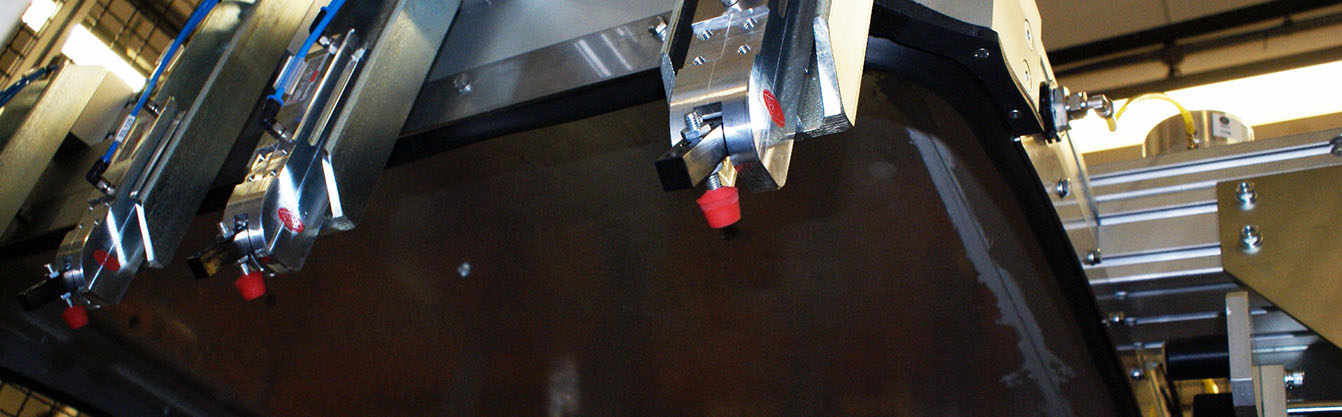
Battery Tray Leak Test Machine
Machine supplied: Battery Tray Leak Testing system with infeed and outfeed conveyors
Client: Leading Automotive Vehicle Manufacturer
Part: Electric Vehicle Battery Tray
Test Method: Pressure Decay (Vacuum)
Test Pressure: 16 mbar (hold for 60 seconds, reject if drops below 14 mbar)
Cycle Time: 90 seconds typical (225 seconds maximum)
The Challenge
A leading automotive vehicle manufacturer needed production leak testing for electric vehicle battery trays. The test requirements included:
- Verification of seal integrity around the entire perimeter flange
- Detection of weld porosity in pressed steel construction
- Identification of incomplete hand-applied sealant coverage
- Automated testing integrated with pallet conveyor system
- Minimal cycle time to match production line throughput
- Large part size requiring custom chamber and sealing system
Electric vehicle battery trays must be completely leak-tight to prevent:
- Water ingress that could cause short circuits and thermal runaway
- Moisture accumulation leading to corrosion of electrical connections
- Coolant leakage from integrated cooling channels
- Battery cell exposure to environmental contaminants
The combination of welded pressed steel, hand-applied sealant, and large perimeter flange creates multiple potential leak paths that must be verified before the tray enters battery assembly.
The Solution
TQC designed a fully automatic battery tray leak testing system with integrated conveyor transport. The system creates a test chamber over the lifted battery tray using a static lid that clamps a P-shaped neoprene seal onto the tray’s perimeter flange. Vacuum pressure decay testing at 16 mbar provides sensitive leak detection across the entire sealed volume. Each battery tray travels on a dedicated pallet through the test station, enabling automated loading, testing, and unloading with pass/fail segregation.
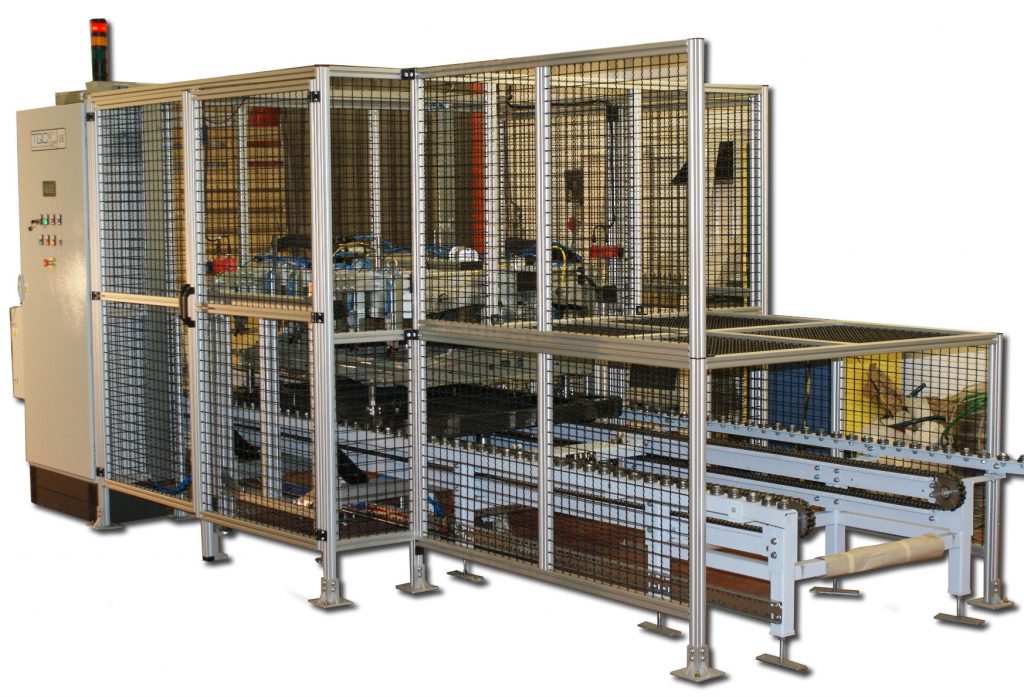
Technical Overview – Battery Tray Leak Testing System
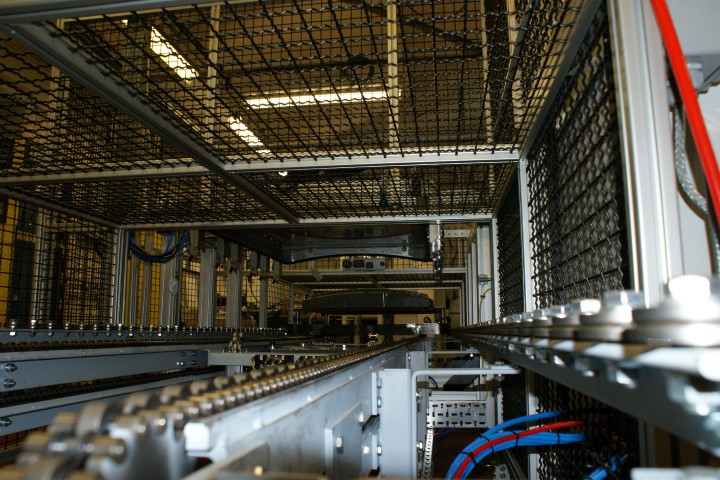
Palletised Conveyor System
Dedicated Pallet Design: Each battery tray sits on a TQC-designed pallet that:
- Supports the tray during transport and testing
- Locates the tray precisely at the test station
- Provides clearance for test chamber sealing mechanism
- Enables automated handling without direct tray contact
Pallet Benefits:
- Protects tray surfaces from conveyor contact and scratches
- Maintains consistent positioning for repeatable sealing
- Allows pallet accumulation for buffering between process steps
- Simplifies integration with upstream/downstream operations
Conveyor Transport: Pallets move through:
- Infeed Conveyor: Delivers pallets with trays to test station
- Test Station: Automated test chamber lid seals and tests tray
- Outfeed Conveyor: Removes tested trays, segregates pass/fail
Continuous Flow: While one tray undergoes testing (90 seconds typical), pallets accumulate at infeed and transfer to outfeed, maintaining production flow.
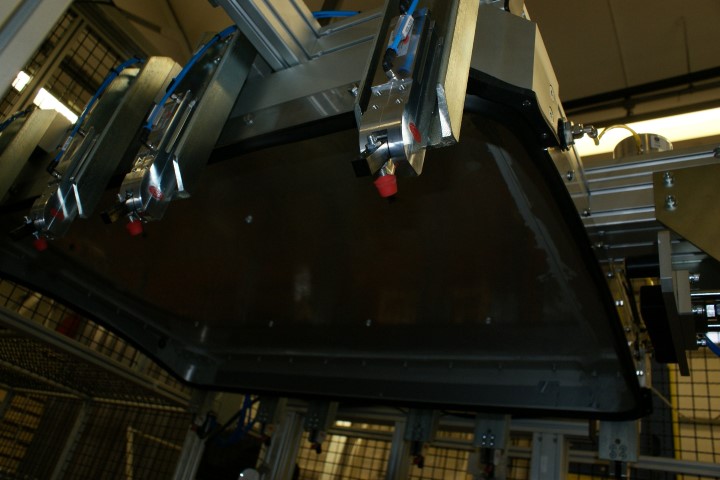
Automatic Chamber and Sealing System – Battery Tray Leak Testing System
Chamber Formation: The leak test creates a sealed volume using the battery tray itself as the base:
Test Chamber Lid: The battery tray is lifted up to a static test chamber lid. The lid includes:
- Perimeter seal groove to accommodate P-shaped neoprene
- Vacuum port connection to test instrumentation
- Structural reinforcement to resist atmospheric pressure during evacuation
- Viewing port for operator observation during testing
Tray Actuation: Pneumatic cylinders raise the test part up to the static lid. Force control ensures adequate seal compression without tray deformation.
P-Shaped Neoprene Seal: The seal design provides:
- P-Shape Cross-Section: Provides sealing on both vertical and horizontal surfaces of the tray flange
- Neoprene Material: Flexible material conforms to surface irregularities while maintaining seal integrity
- Dual Contact: The “P” configuration creates two seal lines – primary and backup – improving reliability
- Flange Sealing: Clamps onto the upturned lip around the tray perimeter
Why P-Shaped Seal: The tray flange geometry (upturned lip) requires sealing both the top surface and the outer vertical face. A simple O-ring would only seal one surface. The P-shape wraps around the flange, creating a continuous seal around the entire perimeter.
Vacuum Pressure Decay Testing
Test Method: The system uses pressure decay at vacuum (underpressure) rather than overpressure:
Why Vacuum Testing: Testing at vacuum (16 mbar, significantly below atmospheric pressure) offers advantages:
- Simulates worst-case service conditions (battery tray sees both pressure and vacuum during thermal cycling)
- More sensitive leak detection than equivalent overpressure test
- Safer than high-pressure testing (no stored energy hazard)
- Detects seal compression issues more effectively
Test Pressure: 16 mbar (approximately 1.6 kPa or 0.23 psi absolute pressure)
Test Sequence:
1. Chamber Sealing: Tray is lifted to the lid and clamps P-seal onto tray flange.
2. Evacuation: Vacuum pump evacuates the chamber to 16 mbar. The evacuation rate is controlled to prevent seal disturbance.
3. Stabilization: Pressure stabilizes as evacuation completes and thermal effects settle. This phase eliminates pressure changes due to temperature equilibration.
4. Test Phase (60 seconds): The chamber is isolated from the vacuum pump. Pressure is monitored continuously for 60 seconds. Any leak allows atmospheric air to enter the sealed volume, causing pressure rise.
5. Pass/Fail Criteria:
- Pass: Pressure remains above 14 mbar throughout the 60-second hold
- Fail: Pressure drops below 14 mbar (indicating leak ingress exceeds acceptable limit)
6. Venting: Chamber vents to atmospheric pressure.
7. Unclamping: Pneumatic cylinders unclamp the part followed by lowering the tray.
8. Pallet Transfer: Pass pallets advance to outfeed; fail pallets route to reject area.
Allowable Leak Rate: The 2 mbar tolerance (16 mbar test pressure, 14 mbar reject threshold) over 60 seconds corresponds to a specific leak rate based on chamber volume. This leak rate ensures battery tray integrity throughout vehicle lifetime.
Manufacturing Process Context
Why Hand-Applied Sealant Requires Testing: The battery tray is manufactured from:
Pressed Steel Components: Multiple stampings welded together to form the tray structure.
Weld Seams: Continuous or spot welds join pressed components. Weld porosity, incomplete penetration, or cracks can create leak paths.
Hand-Applied Sealant: After welding, operators apply sealant by hand to:
- Seal weld seams
- Fill gaps at component joints
- Cover surface imperfections
- Create continuous barrier around perimeter flange
Hand Application Variability: Unlike automated sealant application, hand application introduces variation:
- Inconsistent bead thickness
- Gaps or skipped areas
- Improper curing
- Contamination preventing adhesion
100% Testing Requirement: The combination of welded construction and hand-applied sealant means every tray must be tested. Sampling-based inspection would allow defective trays (potentially causing battery failures) to reach production.
PLC Control System
Programmable Logic Controller (PLC): Manages all test sequencing and material handling:
Control Functions:
- Pallet position detection and indexing
- Chamber lid actuation timing
- Vacuum pump control and pressure regulation
- Test sequence timing (stabilization, hold, vent)
- Pass/fail determination based on pressure monitoring
- Reject routing for failed trays
- Production count logging
HMI (Human-Machine Interface): Touchscreen operator interface provides:
Parameter Editing: Authorized operators can adjust:
- Test pressure setpoint (16 mbar nominal)
- Fail threshold (14 mbar nominal)
- Hold time (60 seconds nominal)
- Stabilization time
- Part variant selection (if multiple tray sizes)
Production Monitoring:
- Real-time pressure display during testing
- Cycle time monitoring
- Pass/fail counts
- Reject rate calculation
- Trend graphs of test pressure over time
Fault Diagnostics: System displays error codes and troubleshooting guidance for common issues (seal wear, vacuum pump performance, pressure sensor drift).
System Specifications – Battery Tray Leak Testing System
- Test Method: Pressure decay (vacuum)
- Test Pressure: 16 mbar absolute
- Pass Threshold: Pressure must remain above 14 mbar for 60 seconds
- Hold Time: 60 seconds
- Cycle Time: 90 seconds typical, 225 seconds maximum (includes load, seal, evacuate, stabilize, test, vent, unload)
- Material Handling: Palletised conveyor system with dedicated pallets
- Infeed/Outfeed: Automated conveyor transfer
- Chamber: Static with structural reinforcement, battery tray lifted.
- Seal Type: P-shaped neoprene (perimeter flange sealing)
- Control: PLC with HMI touchscreen
- Parameter Storage: Editable test parameters via HMI
- Data Logging: Production counts, pass/fail results, cycle times
- Application: Electric vehicle battery trays (pressed steel with welded construction and hand-applied sealant)
Key Features – Battery Tray Leak Testing System
Fully Automatic Operation: Palletised conveyor system enables automated load, test, and unload without operator intervention.
Vacuum Pressure Decay: Testing at 16 mbar vacuum provides sensitive leak detection for large sealed volumes.
P-Shaped Seal Design: Custom neoprene seal accommodates battery tray flange geometry with dual sealing surfaces.
60-Second Hold Time: Extended test period provides confidence in seal integrity and weld quality across the entire tray.
90-Second Cycle Time: Typical throughput matches production line requirements while maximum 225-second cycle accommodates process variations.
Dedicated Pallet System: TQC-designed pallets support trays during transport and provide precise positioning at test station.
Editable Test Parameters: HMI allows authorized operators to adjust pressure thresholds, hold times, and variant-specific settings.
Integrated Conveyor Transport: Infeed and outfeed conveyors integrate with upstream/downstream operations.
Results
The fully automatic battery tray leak test system provides 100% inspection of electric vehicle battery trays at production throughput. Vacuum pressure decay testing at 16 mbar detects leaks in welded steel construction and hand-applied sealant before trays enter battery assembly.
The P-shaped neoprene seal creates a reliable perimeter seal on the tray flange, enabling repeatable testing despite surface variations from manufacturing. The 60-second hold time at 16 mbar provides sufficient sensitivity to catch leak rates that would allow moisture ingress during vehicle lifetime.
Palletised conveyor transport integrates seamlessly with production flow, enabling automated testing without manual handling. The 90-second typical cycle time maintains production throughput while the PLC-controlled system logs all test results for quality documentation.
Detection of weld porosity and sealant gaps at this stage prevents costly battery assembly failures and potential field failures that could compromise vehicle safety.
To view a printer friendly format please click below
Battery Tray Leak Test Machine
If you have an application that could benefit from TQC’s expertise in leak testing, please contact us by email or phone via the contact details
Related Capabilities
This project demonstrates TQC‘s expertise in:
- Vacuum pressure decay leak testing
- Large part chamber design
- P-shaped seal systems for flange sealing
- Palletised conveyor integration
- Automated load/unload systems
- PLC control with HMI interface
- Electric vehicle component testing
- Welded assembly leak testing
- Production line integration
- Data logging and traceability